Ben Gomez: Senior engineer at Google.
In his. previous post. I described the principles and basic components of a convenient, fast and efficient web search. For simple functions such as spell checking, and two-line description of the site in search results, there are sophisticated algorithms. How we develop useful and convenient functions, we tend to appreciate with experiments. This is a small test, performed at our request, small groups of users.
The experiments - a very effective tool, and we commonly use it to test potential changes to search algorithms. At any time on Google sites around the world, held from 50 to 200 experiments. I will start by describing the very small experimental changes that at first glance may not be noticed. And then talk about some of the more illustrative examples. There are many people who are closely watching all the changes search Google ( or even attributing to us an absolutely fantastic thing!). Such people are usually aware of the serious experiments. At the same experiments on small changes remain virtually undetected.
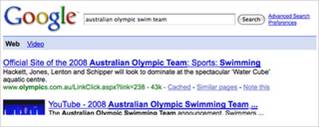
For example, if you can find the differences between the two pages?.
Option 1:.
Option 2:.
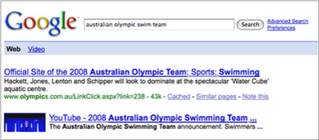
I am absolutely sure that he would, I could not tell them if he saw them separately. But you, then of course you can! . Those who have not guessed, tell me that the empty space around the first search result has been a bit more, so the first result in Option 2 was slightly more pronounced. This change reflects the fact that our ranking algorithms consider that the first result of significantly more relevant. The advantage of this arrangement is that it will help you concentrate on the first search result. But on the other hand, it may interfere with viewing the results of other. The experiments help to understand what change is more significant, and how this varies with the speed of information search.
Another change, which seems to mean a minimum:.


Here the difference is so obvious, it seems, is not difficult to say which option will work best. In this case, the difference - in the thickness plus sign next to the link on the stock price. But when it comes to what is better in terms of search here is not so obvious. The world will turn pink. And fun to sing birds.
Maybe not - but then, at least you will have the best plus sign icon, which we can think of. :).
Of course, not all of our experiments - a crazy vision tests. But these two experiments, I said to emphasize that we are testing almost any change, even small ones, which would seem to be and not worry. In fact, small changes are significant, and we take them seriously.
Another type of experiment concerns the changes that are not purely visual, and refer to the internal algorithms of information. For example, the algorithm is responsible for the formation of the titles and descriptions in search results, now highlights not only the query words, but also their variations and synonyms. For example, at the request of [ Pushkin's poetry ] would display the results to the selected word ...

Isolation of morphological variations of words - it is generally a good idea. This helps you understand what results meet your criteria. It is true, of course, not always. Experiments of this kind help us to confirm ( or sometimes disprove) our understanding of changes in these algorithms.
There is another important type of experiment - a test function, a significant impact on web search. Even for major functions of the purpose of experiments is the same: if we add something really useful for people, or just distract their attention? . There are, of course, well written reference, but most users do not need. One of the goals of the experiment - to see how, in practice, will be used by a particular function. It may differ significantly from our initial ideas.
So, you met with examples of experiments that we are testing all of functions - from the subtle to the most striking and significant. So the next time you go into Google and see that it was a little different, maybe we did... just for you.


